- Capture the exact words the same day, before memory smooths them over.
- Add one line of context and the date to every saying.
- Use a quick voice memo when delivery, not wording, is the funny part.
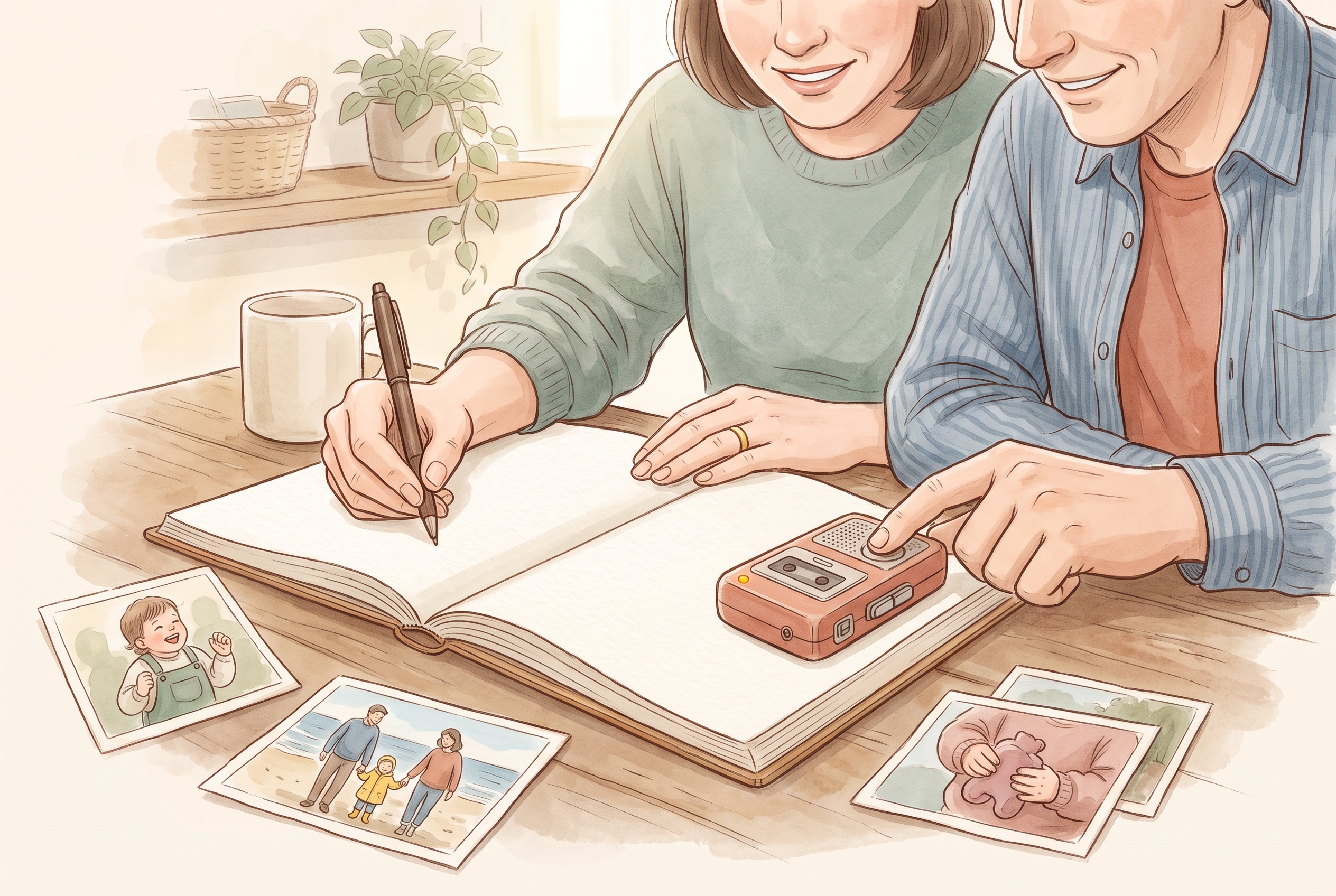
- Keep the words, photo and audio in one place rather than scattered across apps.
You remember that your daughter said something hilarious at breakfast. By dinner you can recall that it was funny, but not the actual words. That gap is normal, and it's exactly what this habit is built to close. The mispronounced words, the odd logic and the bedtime questions are the part of childhood many parents most want back later — and the part that disappears first.
Why the funny things kids say vanish so quickly
Because they're small, frequent and context-dependent. A one-off joke isn't tied to a big event you'll naturally retell, so it slips out of memory within a day or two. Research on everyday autobiographical memory consistently finds that ordinary, unrehearsed moments decay fastest — the gist stays, the exact wording goes.
The exact wording is the whole point. "I remember she said something cute about the moon" is a fact. The actual sentence, in her phrasing, is the thing that makes you laugh out loud five years on. That's why this habit is about verbatim capture, not summary.
The core habit: same day, exact words, one line of context
Capture it while it's still warm. Here is the whole method, in order:
- Write it the same day. Memory for exact wording drops sharply overnight, so the single most important move is speed, not polish.
- Use their exact words. Don't tidy the grammar or correct the mispronunciation — the error is usually the funny part.
- Add one line of context. Where you were, who was there, what prompted it. One sentence is enough.
- Add the date. A bare line with no date loses half its value later.
- Capture the sound when it matters. If the delivery is the joke, record a short voice memo on the spot.
For example (an invented entry, to show the shape): "26 Aug — at the kitchen table. Called the vacuum the 'floor hoover-nurse.' Said it very seriously, twice." Short, dated, verbatim. That's all it takes.
When to write and when to record the voice
Write for the words; record for the way they're said. A running note handles most quotes quickly. But some sayings only land because of how a small voice delivers them — the lisp, the overconfident tone, the pause before the punchline. Those deserve a short audio clip.
A voice memo of ten seconds is worth more than a long clip you'll never replay. If you already have cute phrases buried in old voicemails, our piece on saving voicemails before they expire covers how to rescue them.
Set up a capture spot you'll actually use
The best system is the one that's already in your hand. Pick one place and stick to it:
- A single running note on your phone, titled something you'll find later, with the newest line at the top.
- Your phone's voice recorder for the delivery moments — one tap, done.
- A small notebook by the kettle if you prefer paper for the words.
- A weekly five-minute sweep where you move the good ones somewhere permanent.
The scattered approach — a line here, a screenshot there — is how these moments get lost a second time. Gathering the words, the photo and the audio into one place is the real safeguard. If you're starting from zero, the three-sentences-a-week method is a gentle on-ramp.
Give each saying a little context so it still makes sense later
Context is what turns a line into a memory. "No" means nothing in five years. "No — when I asked if she wanted to leave the swings, arms folded" is a scene. You don't need much:
- The date, always.
- Where you were and who else was there.
- What prompted it — the question, the situation, the thing they were looking at.
- How old they roughly were, if you want (a season or a month is fine).
The gist survives on its own. The exact words and the one line around them are what you have to deliberately save.
Bringing the words, photos and voices together
Once you're catching these lines, they want a home where the quote, a photo from that day and a short audio clip can live together instead of drifting across three apps. A family memory journal is built for exactly that: photos, words and voices kept in one entry, and shared only with the family audience you choose. Kaiary is one option for this — it keeps the typed line next to the recording of how it was said, so the funny thing your kid said is still funny when you read it back. Availability and subscription details are confirmed at sign-up; check the current listing for your country rather than any older marketing.
Key takeaways
- Write funny sayings down the same day — exact wording fades overnight.
- Keep the mispronunciation; don't correct it, it's usually the joke.
- Add one line of context and a date so the line still makes sense years later.
- Record a short voice memo when the way they said it is the point.
How soon should I write down something funny my child said?
The same day, ideally within a few hours. Memory for exact wording drops quickly overnight, so speed matters more than getting the note perfect.
Should I correct my child's grammar or mispronunciation when I write it down?
No. The mistake is usually the whole reason it's memorable. Record the words exactly as they said them, then add one line of context.
Is it worth recording audio instead of just writing the quote?
Record audio when the delivery is the joke — the lisp, the tone, the timing. For most sayings a written line with a date is enough; use short voice memos for the ones that only work out loud.