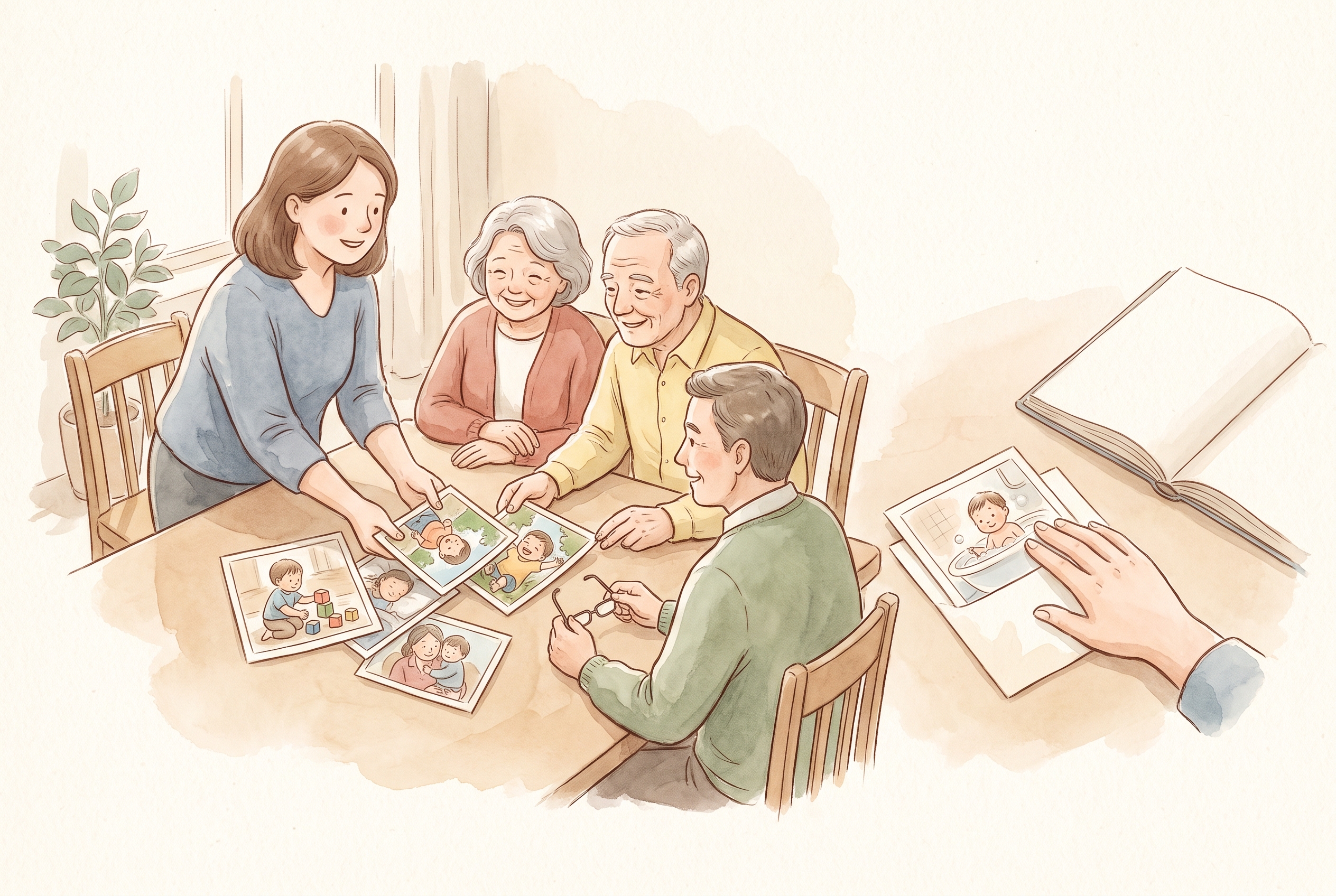
- Lead with the relationship: say it early, kindly, and offer the relative another way to share the same joy.
- Use short, blame-light scripts matched to the person, and always end by offering more access, not less.
- If a photo is already up, ask privately and pair the takedown with the private alternative.
- If someone repeats it, tie access calmly to the behavior — no legal threats, no public call-outs.
The real stake here is a relationship, not a privacy setting. A toggle can hide a photo; it can't repair a grandparent who feels told off. So the goal is to protect your child's footprint *and* keep the warmth that made the relative want to share in the first place.
Below are specific scripts you can adapt, what to do when a photo is already up, and how to handle someone who keeps posting without turning it into a feud. If you want the wider reasoning on why parents hold this line, see why parents keep kids off social media.
Say it early, before the first post
The easiest conversation is the one you have before anyone posts. Set the expectation once, plainly, and pair it with a reason that's about your child rather than about them.
Research and professional guidance on children's digital footprints — including work from pediatric groups and children's-privacy advocates — makes a consistent point: a public photo can travel and persist beyond your control, and a child can't consent to it. You don't need to lecture anyone with that; you just need to state your family's choice clearly.
For example, you might say: "We've decided to keep her off public feeds for now so she gets to make that call herself one day. It's not about the photo being anything but lovely — we'd just rather it lived somewhere private."
Three short scripts you can borrow
Match the script to who you're talking to. Keep it short, specific, and end with the alternative so they don't feel shut out. These are examples to adapt, not lines to memorize.
- For a co-parent or partner, aligning first: "Can we agree we don't post his face publicly, and we send the same request to both our families together? It lands better coming from both of us."
- For an in-law you don't know well: "I love that you want to show him off. We're keeping his photos off public accounts — would it be okay if I added you to a private spot where you get every picture first?"
- For a proud grandparent: "You're his biggest fan and I want you to have all of these. We're just not putting him on open feeds. Let me set you up somewhere you'll never miss a photo."
What to do if a photo is already up
Assume good faith and ask once, privately, without an audience. A public comment on their post turns a small request into a scene.
- Message them directly, not in the comments: "Gorgeous photo — would you mind taking this one down? We're keeping his face off public posts. Totally my fault for not saying sooner."
- Take the blame for the mix-up, even if it isn't yours. It removes the sting and makes removal feel like teamwork.
- Follow up with the fix immediately: send them the private alternative so the takedown comes with a gain, not just a loss.
- If they ask why, keep the reason about your child and short. You don't owe a debate.
When a relative keeps doing it
If the same person posts again after a clear request, name the pattern calmly and move from request to boundary — without declaring war. The line is: be firm about the outcome, soft about the person.
Say what you'll do, not what they must feel: "I've asked a couple of times now, so I'm going to stop sending photos to anyone who posts them publicly, and I'll really miss sharing with you. The moment they're staying private, I'll add you straight back in." That ties access to the behavior without insults, ultimatums, or family-group drama.
Avoid legal threats. For nearly every family this is a relationship problem, and framing it as a rights dispute usually costs you more than the photo was worth. If you want a parallel script for institutions rather than relatives, our guide on asking schools and clubs to keep photos off public feeds covers that case.
Give them the joy somewhere private
The request lands when the relative still gets everything — often more than they'd have seen on a feed. The real objection is rarely "I need strangers to see this baby." It's "I don't want to be cut off from these moments." So close that gap.
Choose a private space where you control who's invited and what they can see, then actively send the good ones. When Grandma gets the first laugh, the messy-dinner face and the nap pile delivered straight to her, the public feed stops mattering. If you're weighing who should be in that circle, see how to decide who can see a family memory.
Where Kaiary fits
A family memory journal keeps the photos, words and voices of everyday life in one place, and lets you share them only with the people you choose through chosen family audiences — so a proud grandparent gets every photo and the laugh you recorded, without any of it touching a public feed. You decide who's invited and what they see; read our privacy promise for the specifics, and note that availability and features vary by store and plan. It's one practical way to make "please don't post, but here's everything" a real offer rather than a brush-off.
An honest limitation
No conversation or tool guarantees a relative will comply, and once something has been public you can't be sure every copy is gone. What you can do is reduce how much goes public, make the private route genuinely better, and keep the relationship intact enough that the next request still gets heard.
How do I ask family not to post my baby on social media without causing a fight?
Ask once, privately, and keep the reason about your child rather than about them. End with an offer: give them a private place where they'll get every photo, so the request feels like more access, not a punishment.
What should I do if a grandparent already posted my child's photo?
Message them directly rather than commenting publicly, take the blame for not mentioning it sooner, and ask kindly for it to come down. Then immediately send them the private alternative so removal comes with a gain.
What if a relative keeps posting after I've asked them to stop?
Name the pattern calmly and tie access to the behavior: stop sending photos to anyone who posts them publicly, and restore access as soon as they keep things private. Stay firm about the outcome and warm about the person.