- Sharenting means parents posting children's photos and details publicly; choosing not to is a reasonable default now, not an accusation of anyone who does.
- Public photos travel past your chosen audience through screenshots, reshares and scraping — Human Rights Watch found real children's photos in an AI training dataset in 2024.
- Backgrounds and captions often reveal schools, routines and locations; strip that context or keep those scenes out of public feeds.
- You can keep the pride and closeness by sharing privately with a chosen audience instead of an open platform.
What sharenting means, and why the word matters
Sharenting is the habit of parents sharing images and details of their children on social media and other public feeds. It is ordinary, affectionate and almost universal. Naming it is not an accusation. It simply lets us talk about one specific thing: putting a child's everyday life in front of an audience the child did not choose and cannot later un-choose.
Parents who post are not villains. Most are proud, far from family, and using the easiest tool they have. The question this article asks is narrower: given what public platforms now do with images, is public posting still the sensible default — or is keeping a child's life inside the family the calmer choice?
The child gets no say now, and will read it later
A short answer: your child cannot consent to a public post, and one day they will be old enough to find it. A birthday meltdown, a bath photo or a funny caption lives on long after the moment passes. The person in the picture never agreed to the audience.
This is not about catastrophe. It is about respect for a future adult who may feel differently about their younger self than you do today. Keeping the memory does not require publishing it. You can hold the image, the words and the sound of the moment without broadcasting them.
Photos travel past the audience you picked
A short answer: once a photo is public, you no longer control where it goes. Screenshots, reshares and automated scraping all move an image beyond your followers list. A tight audience setting on one platform does not bind the next person who saves the file.
Human Rights Watch reported in June and July 2024 that it found identifiable photos of Brazilian and Australian children — some with the children's names — inside LAION-5B, a large dataset used to train image generators. Many of those photos had been posted in ordinary, personal contexts. That is the mechanism in plain terms: a picture shared for family ends up in a machine-training pile, without anyone asking.
Captions and backgrounds give away more than the face
A short answer: the details around a photo often identify your child's school, route and daily routine. A uniform logo, a street sign, a team name, a geotag or a repeated after-school time builds a map of where a child reliably is.
If you do post, strip the context: no school crests, no house numbers, no standing locations, no predictable timestamps. Better still, keep those everyday scenes out of the public feed entirely. If your concern is institutions rather than your own posts, see our guide on how to ask schools and clubs to keep your child's photos off public feeds.
AI can now reuse any public face
A short answer: a public photo of a child can be scraped, used to train image generators, or recombined into new images — without consent and without you ever knowing. That capability is new, and it changes the maths on public posting.
France's law n° 2024-120 of 19 February 2024 reflects this shift, treating a child's image as something to be protected rather than freely broadcast. You do not need to accept any particular legal theory to act on the practical point: the fewer public photos of your child exist, the fewer can be reused.
Why parents share anyway — and the private alternative
People share for good reasons: grandparents live far away, pride is real, and belonging to a group of other parents feels like support. The instinct is not the problem. The audience is.
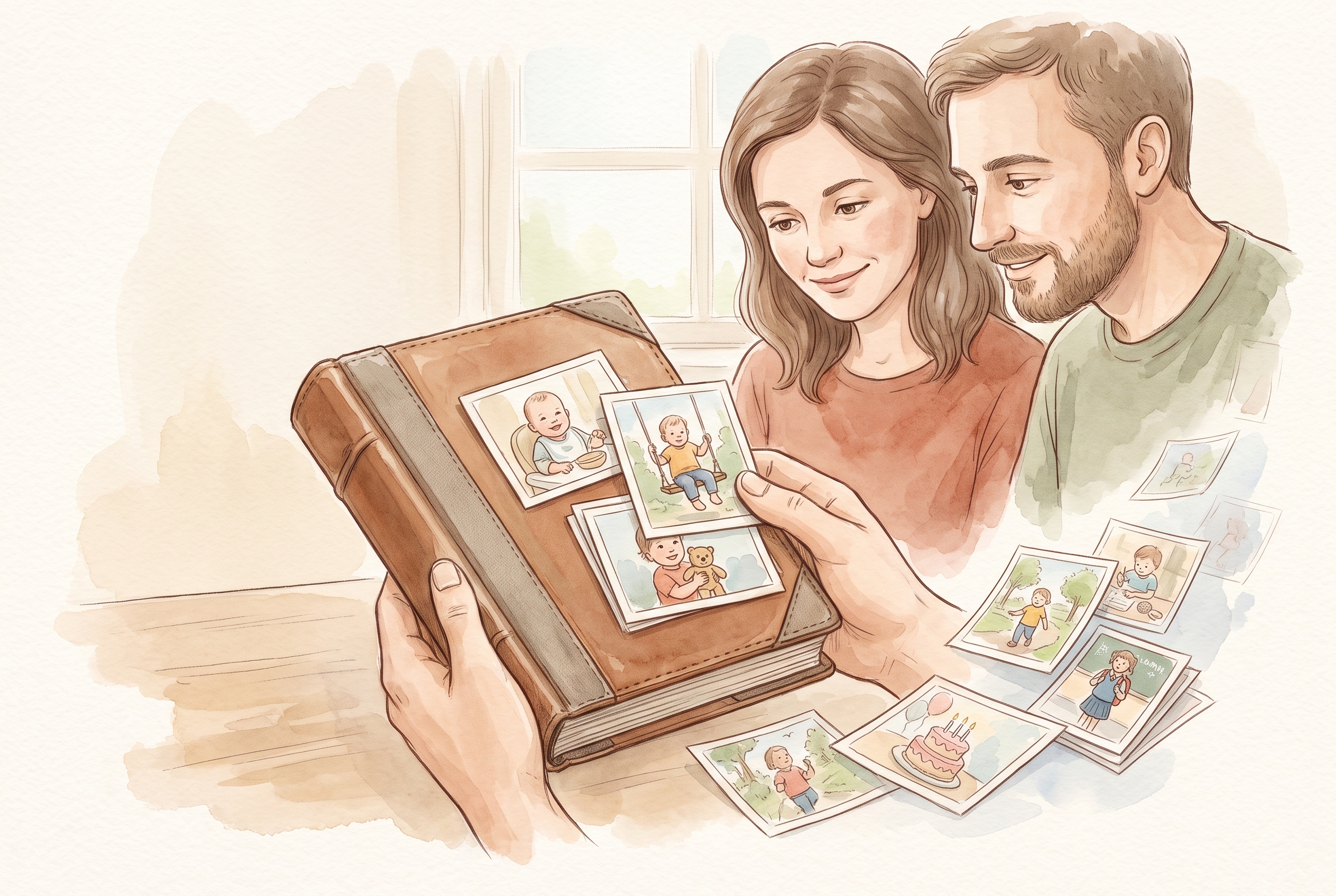
The private alternative keeps the warmth and drops the exposure. Instead of posting to the open feed, you keep the photo, the caption and even the sound of the moment in one place and invite only the people you choose. Here is a practical sequence:
- Decide who truly needs to see a given memory — often a short list of grandparents, a partner, and a few close relatives, not a public audience.
- Keep the photo together with its words and, where it helps, a short voice note, so the moment stays whole rather than scattered across apps.
- Set the audience deliberately for each entry or collection, so distant family sees the update while the wider internet does not.
- Review your older public posts periodically and remove what no longer needs to be public, especially anything showing routines or locations.
If you want a lightweight way to begin, our note on how to start a family journal with three sentences a week keeps the habit small enough to actually stick.
One private place to keep and share it
If you want the private alternative in one tool, Kaiary's family journal keeps photos, words and voice together in a single entry, and family sharing lets you invite only the people you choose rather than a public feed. You decide the audience for what you share, so a grandparent can see the week's photos without the picture entering a public, scrapeable stream. Availability, features and trial terms are confirmed at sign-up and on the App Store listing for your region; see our privacy promise for how Kaiary describes its own data choices.
This does not erase the public web or guarantee perfect control of anything already posted. It gives you a smaller, chosen audience for what you keep from here on.
What does sharenting mean?
Sharenting is when parents share photos, videos or details about their children on public or semi-public platforms. It is common and usually affectionate, but it puts a child's life in front of an audience the child did not choose.
Is it wrong to post photos of my kids online?
No — parents who post are not villains. The concern is practical: public photos can be screenshotted, reshared or scraped into AI training data, and your child gets no say now and may feel differently later. Sharing privately with chosen people avoids most of that exposure.
How can I share photos with family without posting publicly?
Keep each memory's photo, words and voice together, and invite only the specific people you want to see it rather than posting to an open feed. Set the audience deliberately for each entry so distant relatives can see updates while the wider internet cannot.