- The ordinary days — breakfast, car rides, bedtime songs — are the ones most worth prompting for, because they vanish quietly.
- Answer prompts in the moment and in one or two sentences; short and specific beats complete.
- Group prompts by time of day and season so there's always one that fits the moment you're in.
- Gaps are normal. A record with holes is still a record worth keeping.
Milestones get photographed on their own. Nobody forgets the first steps or the birthday cake. What slips away is the shape of a regular Tuesday: who sat where, what made everyone laugh, the phrase someone repeated all month. These prompts are deliberately low-effort. A sentence is enough. If you'd rather build a quiet weekly rhythm instead of working from a list, see how to start a family journal with three sentences a week.
How to use these family journal prompts
Pick one prompt that matches the moment you're in and answer it in one or two plain sentences. Don't save them for a calm evening that never comes. The point is to catch the ordinary while it's still happening.
- Answer in the moment or within a day — detail fades fast.
- Keep it short: a sentence beats a blank page.
- Skip any prompt that doesn't fit; there's no order to follow.
- Name who was there and one concrete detail (a word, a smell, a sound).
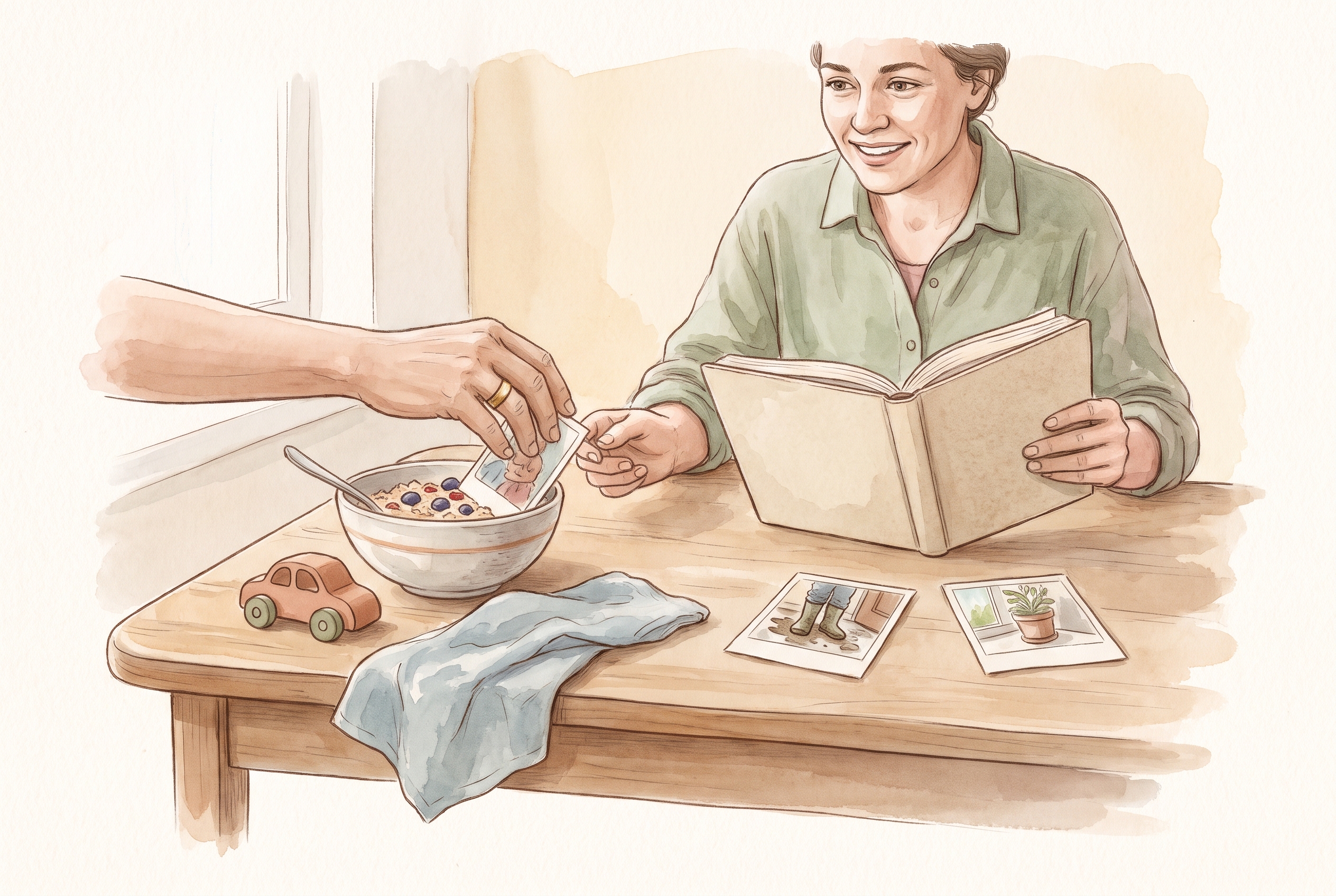
If you want a worked model, here is one entry, clearly invented as an example. For example: "Breakfast, rainy Monday. She refused toast unless it was 'triangle toast,' then ate it in two bites and declared triangles 'the best shape.' The radio was playing that song she hums in the bath." That's the whole entry. Enough to remember the morning.
Morning prompts
Mornings are the richest ordinary hours and the first to be forgotten. These catch the chaos before coffee.
- What was the first thing someone said out loud today?
- Who was the last one ready, and why?
- What did breakfast actually look like — not the ideal, the real one?
- What song, show or sound was on while you got out the door?
- What small argument or negotiation happened before 9am?
- What did someone wear that they insisted on?
Midday and car-ride prompts
The in-between hours hold the questions you never see coming. Jot the question, not just your answer.
- What unexpected question got asked in the car or on a walk today?
- What did someone become obsessed with this week?
- What made everyone laugh at the table?
- What's the phrase being repeated around the house right now?
- What did a quiet afternoon actually consist of?
Car-ride questions and odd one-liners are their own small genre. If you want a method for keeping them without polishing them into something they weren't, read funny things kids say and why to write them down.
Evening and bedtime prompts
Evenings are where the day settles. These prompts catch the winding-down rituals you'll barely notice until they're gone.
- What was the best part of today, according to someone else?
- What's the current bedtime negotiation or ritual?
- What book, song or story was requested tonight?
- What did someone say right before falling asleep?
- What did the house sound like once it went quiet?
Seasonal prompts across the year
Seasons change the ordinary in ways you forget between years. These prompts work once a season, not daily.
- Spring: What's the first thing everyone wanted to do outside?
- Summer: What was the drink, snack or game on repeat?
- Autumn: What changed in the daily routine as it got darker earlier?
- Winter: What's the warmest small ritual of these months?
- Any season: What smell defines right now in your home?
- Any season: What's everyone complaining about, and what's everyone grateful for?
- Year turn: What's one ordinary thing you'd miss if it stopped tomorrow?
If a year's worth of these starts piling up, you don't have to rewrite them into something tidy. Organising a year of family memories without rewriting it covers keeping the rough originals and still finding them later.
No guilt about the gaps
You will miss days. Weeks, even. That's not a failure of the system; it's how ordinary life works. A family record with gaps is still a record. The prompts above are invitations, not obligations — answer the ones that catch you, leave the rest. The goal is to have more of the small true moments than you'd otherwise keep, not to document everything.
The entries you'll reread aren't the complete ones. They're the specific ones.
Where the prompts, photos and voices can live together
A prompt answered on a sticky note gets lost. A prompt answered next to the photo from that morning, with the voice note of the laugh attached, stays findable. A family memory journal is built to keep the words, photos and audio of these ordinary days in one place, so a one-sentence breakfast note and the picture of the triangle toast sit in the same entry — and you decide, through chosen family audiences, who gets to see them. It's one option for turning this list into something you'll actually reread.
What makes a good family journal prompt?
A good prompt points at a specific, ordinary detail you can answer in one or two sentences — a phrase being repeated, a question from the car, the morning's real chaos — rather than a vague milestone.
How often should I use family journal prompts?
As often as a moment catches you, which might be daily or once a week. Seasonal prompts work just a few times a year. There's no streak to keep and no penalty for gaps.
Should I record the exact words someone said?
Write what you remember and mark it as remembered rather than an exact quote. If the words matter, capturing a short voice note alongside the entry keeps the real sound instead of a paraphrase.