- As of this writing, Meta uses public posts and photos from adult accounts to train its AI; private messages are excluded and camera-roll cloud processing is opt-in.
- "Public" is an audience setting you control — the single most effective change is making accounts private and not posting children's faces publicly.
- Once an image is public it can spread beyond one platform; Human Rights Watch found scraped children's photos in an open training dataset in 2024.
- Kaiary uses AI with documented third-party providers too; we link our privacy promise rather than claim no AI processing.
Does Instagram use my photos to train AI?
Yes, within limits Meta has stated publicly. Meta announced it would use public posts, photos and captions from adult accounts on Facebook and Instagram to train its generative AI, including rolling this out in the EU from 27 May 2025 with an objection form for people in that region. Meta has said private messages are not used. The key word is "public." A photo set to a public audience is in scope; a photo shared only with chosen followers or friends is treated differently.
This is a dated snapshot. Platform policies change, and the exact wording, regions and opt-out mechanics shift over time. Check the current notice in your own app settings rather than trusting an old screenshot — including this one.
What "public" actually means on your account
"Public" is an account and audience setting, not a vague mood. It determines who can see a post without following you — and, under Meta's stated approach, whether that content is eligible for AI training.
- A public Instagram account: anyone can view your photos, and your posts are in scope for the training Meta described.
- A private Instagram account: only approved followers see your posts, which changes who can access them.
- Stories, highlights and tagged photos: a public account's stories and the posts others tag you in can still be publicly visible even if you post carefully.
- Other people's posts of your child: a relative's or friend's public post is governed by their account settings, not yours.
That last point matters most for families. You can lock down your own account and still have a child's face sitting in someone else's public feed. If that's a worry, it's worth a direct, kind conversation — we walk through how in asking relatives not to post your child's photos.
What we know, and what we don't
Be honest about the edges. Here's what is on the record versus what isn't.
On the record: Meta's stated use of public adult-account content for AI training; its stated exclusion of private messages; and the fact that Meta's camera-roll cloud processing on Facebook is an opt-in feature you have to turn on. Separately, Human Rights Watch reported in 2024 that LAION-5B, a large open dataset used to train AI models, contained scraped public photos of identifiable children — a reminder that once an image is public on the open web, it can be copied into datasets far beyond the original platform.
Not known or not clearly disclosed: exactly which past public posts have already been used, how long training data persists, whether deleting a post removes it from models already trained, and the full list of downstream datasets any single image might reach. Treat anyone claiming certainty on those points with caution.
How to reduce your family's exposure, step by step
You don't need to delete everything. You need a few deliberate choices. Here's an ordered approach, lightest effort first.
- Set your account to private. On a private account, new posts aren't publicly viewable, which changes their eligibility. Five minutes, highest payoff.
- Review old public posts. Archive or remove public photos of children you'd rather not have in open circulation. This takes longer but closes the most exposed gaps.
- Leave camera-roll cloud processing off. Meta's camera-roll cloud feature on Facebook is opt-in; if you never turned it on, leave it off, and check that it's off.
- If you're in a region with an objection form, use it. Meta offered an objection route in the EU; availability depends on where you are.
- Stop posting faces publicly for new memories. The surest exposure is zero exposure. Keep the everyday photos in a private place and share them to chosen people instead.
That last habit is the real shift. For many families, the camera roll is where the details live anyway — and whether details belong in a photo journal or a camera roll is worth thinking through before you rely on any public feed.
Why AI changes the stakes for children's faces
A public photo is no longer just a photo someone might glance at. It can be copied into training data, and it can seed convincing fakes. The dangers aren't hypothetical: scraped children's images in open datasets, and voice and face cloning used in scams, are documented concerns. If you want the fuller picture, read what AI changes about posting children's pictures and consider setting up a family code word against voice-clone scams.
None of this means social media is off-limits for every family. It means the default of posting a child's face to a public audience deserves a second thought it rarely used to get.
Being honest: Kaiary uses AI too
We won't pretend otherwise. Kaiary uses AI to help with things like captions and illustrated storybook pages from your real memories, and some of that relies on documented third-party providers. That's different from a public social platform training general models on your photos — but you deserve the specifics, not a slogan. We set out what's processed, by whom, and the choices you control in our privacy promise. AI in Kaiary assists your words and images; it does not invent events or fabricate a voice as if it were real.
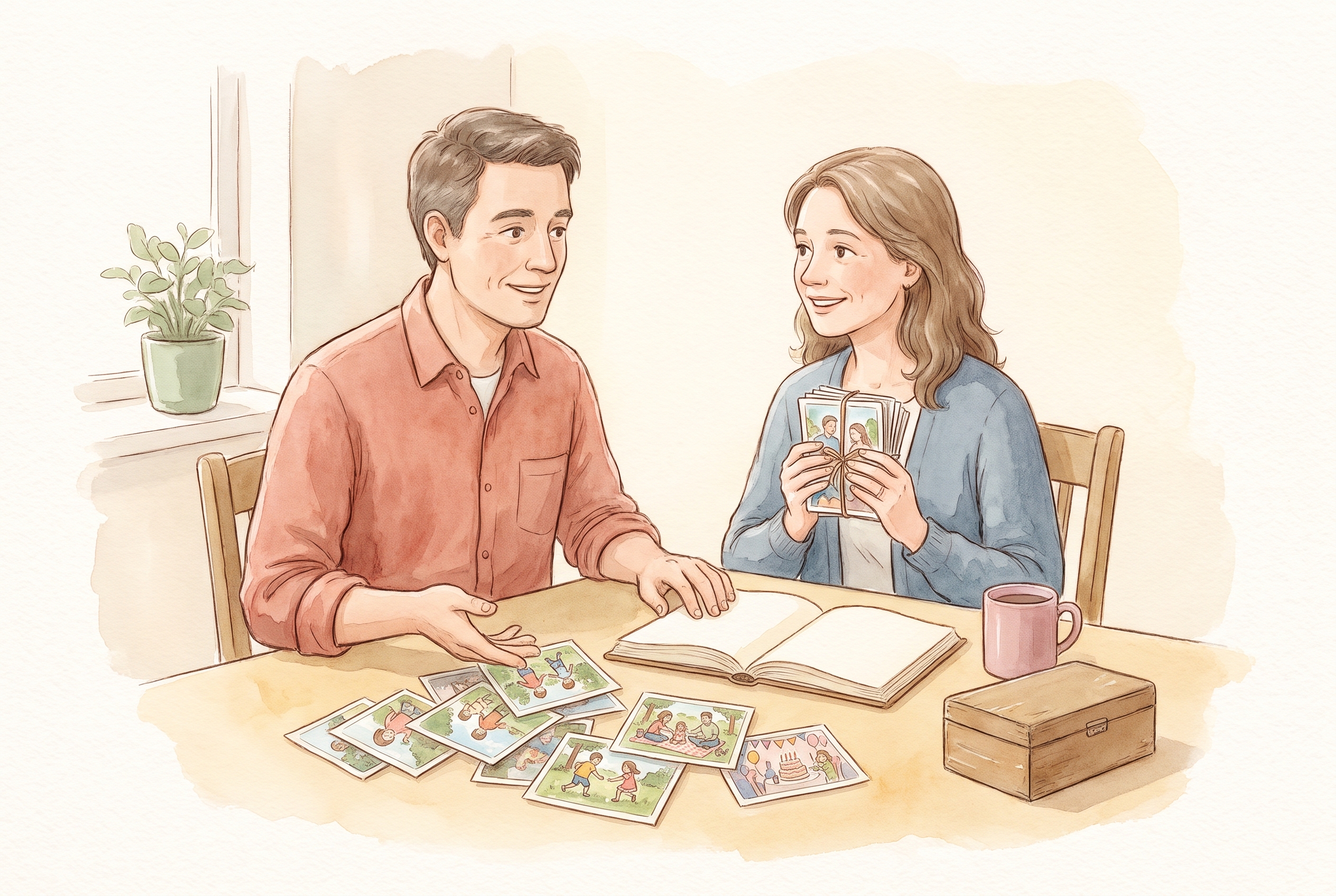
If keeping everyday photos out of public feeds appeals, the plainest alternative is a private place that keeps photos, words and voices together, shared only with people you invite. That's what the family journal is for: you choose the audience for every memory in family sharing, instead of posting to the open web. It's one option among several — but it's built around the audience choice this whole article turns on.
The reliable lever you control is the audience you choose at the moment you post — not a policy you hope holds up later.
Does making my Instagram account private stop AI training?
Under Meta's stated approach, AI training uses public content from adult accounts, so switching to private changes the eligibility of your new posts. It does not undo training on anything that was already public.
Are my private messages or DMs used to train Meta's AI?
Meta has said private messages are excluded from the content it uses to train its AI. The content in scope is public posts, photos and captions from adult accounts.
If I delete a public photo, is it removed from the AI?
Deleting a post can stop future access, but it is not clearly disclosed whether an image already used is removed from models already trained. Assume anything once public may persist somewhere.